VR SEO That Helps Virtual Reality Firms Get Found
Virtual reality websites can showcase impressive experiences yet remain hard to find through search. Our VR SEO approach improves discoverability through technical work and buyer-focused content.
Trusted by large companies worldwide















Introduction
Make Your VR Business Easier to Find
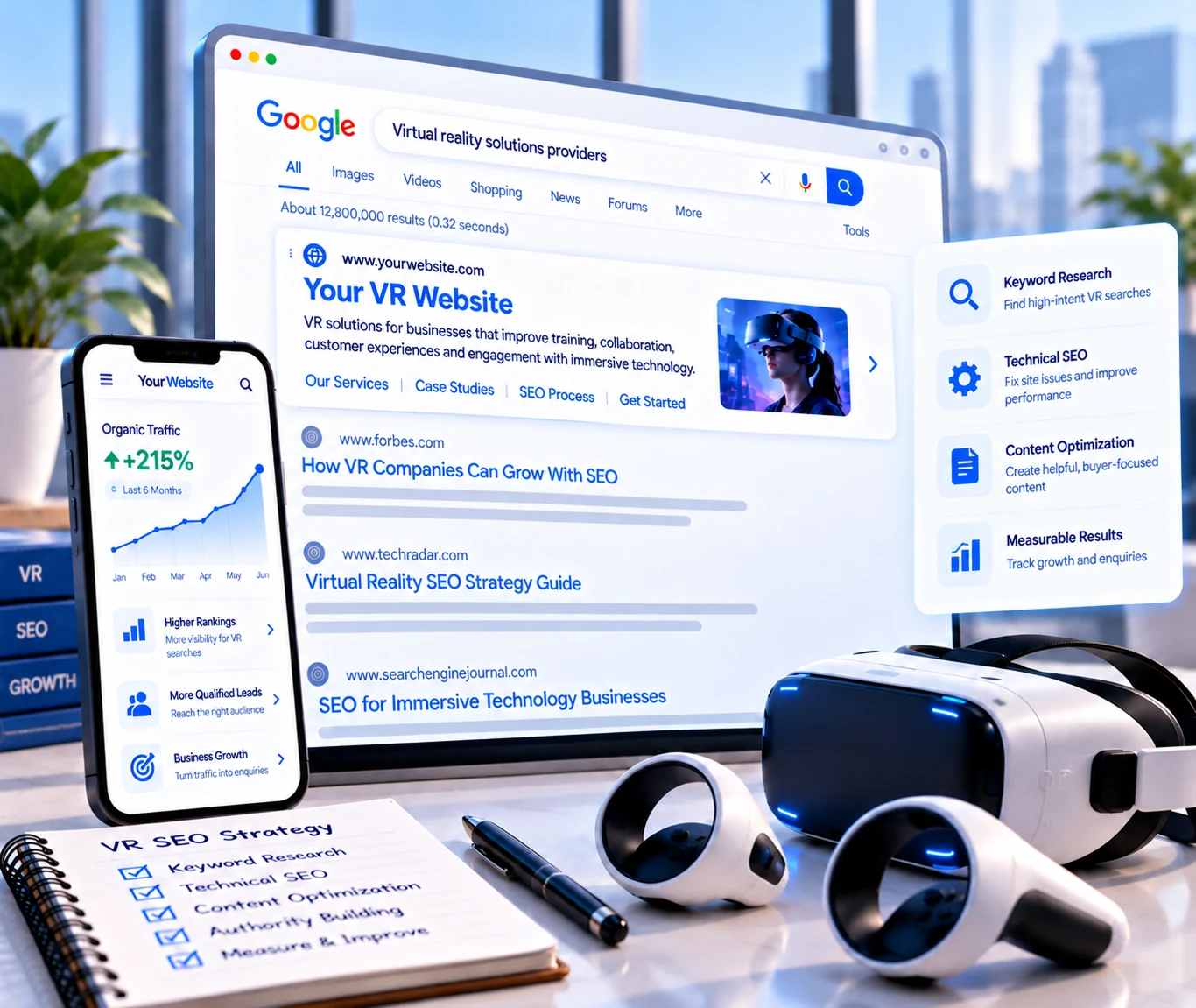
VR SEO helps virtual reality businesses appear for searches their potential customers actually use. It addresses technical barriers, content gaps, and mismatches between terminology and buyer needs.
Visibility
Relevance
Measurement
Our Capabilities
- VR Buyer Keyword Research
- Technical SEO Audits
- JavaScript Rendering Analysis
- Core Web Vitals Optimization
- Structured Data Implementation
- Education-Focused Content Strategy
- Ongoing SEO Performance Monitoring

VR SEO Strategy
SEO Built Around Virtual Reality Businesses
Virtual reality SEO makes VR companies discoverable through traditional search. It connects buyer-focused keywords, technical improvements, useful content, and ongoing performance measurement.
01
What Does VR SEO Include?
The service combines search strategy, technical SEO, content optimization, and ongoing monitoring. It can include keyword research, competitive analysis, site architecture planning, structured data, local SEO, and content frameworks aligned with customer questions.
02
Why Does Specialized SEO Matter?
Immersive experiences, 3D models, and interactive environments are not always directly discoverable through search engines. Without supporting pages and clear technical signals, important offerings may be difficult for potential customers to find.
03
How Does the Strategy Address These Challenges?
VR search engine optimization examines how buyers search, how search engines access website content, and where useful information is missing. Prioritized improvements can help search engines understand relevant pages and help prospects find answers.
04
Who Can Benefit From This Service?
The service is designed for virtual reality development companies, VR training providers, simulation studios, enterprise VR solution providers, and immersive technology agencies. It can also support AR/VR businesses that want stronger visibility for their VR offerings.
Our Approach
Qrolic’s workflow starts with business goals and measurable outcomes, then moves through keyword research, site structure, technical fixes, content optimization, and ongoing improvement. This keeps SEO decisions connected to customer needs and recorded performance data.
Benefits
Build Stronger Search Visibility for VR
A focused SEO strategy can help your business reach more relevant searches and explain complex VR offerings clearly. Results depend on competition, implementation, and market conditions.

Reach the Right Buyers
Target outcome-based searches related to training, simulation, and enterprise solutions. This helps align website content with the needs of potential customers.

Address Technical Barriers
Identify rendering and indexation issues that may prevent important pages from appearing in search. Prioritized fixes give search engines clearer access to your content.

Improve Media-Heavy Pages
Review Core Web Vitals and mobile performance on pages containing video, 3D assets, and interactive elements. Improvements can support a better page experience.

Educate Potential Customers
Build content around use cases, implementation questions, and buyer concerns. Helpful information can guide prospects from early research toward vendor evaluation.

Strengthen Local Discovery
Develop a local SEO strategy for businesses serving geographic markets. This can help eligible VR providers target searches for nearby implementation partners.

Measure SEO Progress
Set up analytics and conversion tracking before optimization begins. Reporting can connect search activity with enquiries and other defined business goals.
Help the Right Buyers Discover Your VR Solutions
Free VR SEO Analysis
Explore an SEO strategy shaped around your audience, website challenges, and business goals.

Our SEO Workflow
How Our VR SEO Process Works
The process follows Qrolic’s SEO workflow, combining related stages while preserving their original sequence and purpose.
01
Align Business Goals
02
Make Results Measurable
03
Research Buyer Searches
04
Structure and Audit the Website
05
Improve Content and Pages
06
Strengthen Technical and Local SEO
07
Improve Conversion Opportunities
08
Build Authority and Refine Strategy
09
Protect SEO During Site Changes
Step 01
Align Business Goals
We establish your audience, services, target markets, competitors, and business objectives. This gives the SEO strategy a clear business direction.
Step 02
Make Results Measurable
Analytics, Search Console, and conversion tracking establish a baseline before optimization. This helps measure progress beyond rankings and traffic alone.
Step 03
Research Buyer Searches
We examine keyword intent, search demand, competitors, and opportunities. The strategy prioritizes the outcome-based terms potential customers use, not only technical VR terminology.
Step 04
Structure and Audit the Website
Site architecture, URLs, content topics, and internal links are reviewed alongside SEO issues. This helps reveal structural barriers and makes priorities clearer.
Step 05
Improve Content and Pages
Existing pages are optimized, and useful content is planned around customer questions and search intent. This supports prospects through awareness and evaluation.
Step 06
Strengthen Technical and Local SEO
Technical work addresses crawlability, indexing, site speed, Core Web Vitals, mobile usability, and related issues. Local SEO supports discovery in relevant geographic markets.
Step 07
Improve Conversion Opportunities
Calls to action, page layouts, user experience, and trust signals are reviewed. The aim is to help relevant visitors take meaningful next steps.
Step 08
Build Authority and Refine Strategy
Link-building opportunities, brand mentions, rankings, traffic, and conversions are monitored. Performance data informs ongoing improvements as markets and search systems change.
Step 09
Protect SEO During Site Changes
For a redesign or migration, redirects and URL preservation are planned, and performance is compared around launch. This helps reduce the risk of losing existing search visibility.
Comparison
VR SEO Versus a Generic SEO Approach
Generic SEO may overlook the technical and buyer-education challenges of immersive technology websites. A VR-focused strategy considers these needs when planning search improvements.
Other Services
Without Qrolic :
- Broad, generic keyword targeting
- Technical terms prioritized alone
- Limited rendering investigation
- General performance recommendations
- Content focused on product features
- Local searches left unaddressed
- Rankings lack conversion context
Qrolic Technologies
With Qrolic :
- Buyer-intent VR keyword research
- Outcome-based search opportunities
- JavaScript rendering audit
- Core Web Vitals review for media
- Education-first content frameworks
- Local SEO strategy where relevant
- Analytics and conversion tracking
Case Studies
Measure Progress With Clear SEO Goals
VR SEO should be evaluated using recorded performance data, not unsupported promises. Qrolic’s workflow establishes measurement before optimization so progress can be reviewed against defined goals.

WordPress Performance Optimization Case Study – Active Steel Forge Speed & SEO Improvement
Overview Active Steel Forge had a highly data-heavy WordPress website…
Highland Transfers Website Redesign & Development & SEO Optimization
Overview Highland Transfers is a professional transportation service offering reliable…
Diamond DJ Entertainment Website Design & Development
Overview Diamond DJ Entertainment is a professional event entertainment service…

SEO-Optimized Website for Design Agency – Vini Infotech
Overview Vini Infotech is a graphic design and creative solutions…
Why Choose Qrolic
A Measurable SEO Approach for VR Businesses
VR companies need more than keyword placement. Qrolic’s SEO workflow connects goals, technical reviews, content improvements, and monitoring, without treating rankings or traffic as guaranteed.
0+
Years of WordPress
Delivering top-tier digital services across design, development, and performance.
0+
Happy Clients
Serving global brands with a 95%+ satisfaction rate across industries.

0%
Client satisfaction
We’re committed to delivering solutions that truly make an impact.
0+
Team members
A strong team of experts in WordPress, web technologies, and UI/UX.
VR SEO Packages
Virtual Reality SEO Packages
Select the perfect VR SEO package for your virtual reality business. Each plan is crafted to boost visibility, attract users, and deliver measurable ROI in the immersive market.
Basic SEO Plan
Local businesses or startups
10 keywords$150-$200/month
- Site audit and on-page fixes
- Google Business Profile setup
- Monthly reporting
- Basic keyword optimization
- Local citation building
Growth SEO Plan
Small to mid-sized businesses
20+ keywords$250-$350/month
- Content creation and optimization
- Technical SEO improvements
- Link-building campaigns
- Conversion tracking setup
- Advanced reporting dashboard
Pro SEO Plan
National or highly competitive websites
40+ keywords$600+/month
- Premium content strategy
- Advanced technical SEO
- Conversion rate optimization
- Priority support
- Comprehensive analytics
Custom SEO Plan
Enterprise & Niche Clients
Fully tailored SEO strategy with dedicated team and advanced analytics
Premium Features
- Dedicated SEO team (5-8 specialists)
- Custom analytics dashboard
- International/multi-location SEO
- Technical CRO integration
- Advanced competitor intelligence
- White-label reporting options
Join 70+ enterprise clients who trust Qrolic for their SEO success
Plan Your Next Steps
Let’s Discuss Your VR SEO Goals
Tell us about your VR business, target audience, and current search challenges. This gives the conversation a useful starting point for discussing relevant SEO priorities.
Estimate Your VR SEO Investment? Free
Our SEO cost calculator provides a transparent estimate
based on real project data for the virtual reality industry.


Estimate Your VR SEO Investment? Free
Our SEO cost calculator provides a transparent estimate
based on real project data for the virtual reality industry.
Frequently Asked Questions
Common Questions About VR SEO
Understand how virtual reality SEO works, which challenges it addresses, and what to consider before starting. These answers explain the service scope and its practical focus.
What is VR SEO and why does it matter?
VR SEO is search engine optimization designed for virtual reality businesses. It focuses on buyer-focused keywords, technical website issues, supporting content, and structured data to help people discover VR solutions through traditional search.
How is virtual reality SEO different from general SEO?
Virtual reality SEO considers challenges such as JavaScript-dependent content, media-heavy pages, and the difficulty of making immersive experiences discoverable. It also emphasizes searches based on buyer outcomes and content that explains VR use cases.
Can Google directly index VR environments and 3D models?
VR environments and 3D models are not generally indexed like ordinary text-based web pages. Supporting pages, descriptive content, metadata, and structured data can help search engines understand the products, services, and experiences being presented.
What does SEO for VR companies include?
The service can include buyer search analysis, keyword research, competitive analysis, technical audits, content optimization, structured data, local SEO strategy, and ongoing monitoring. The appropriate scope depends on the website, audience, and business objectives.
How will we measure VR SEO progress?
Qrolic’s workflow places analytics, Search Console, and conversion tracking before optimization. Reporting can then review rankings, traffic, conversions, and other agreed measures to help assess progress and guide future improvements.
How long does virtual reality SEO take to work?
SEO is an ongoing process, and timing varies with competition, website condition, content quality, and implementation. Technical improvements and longer-term content or authority work may show effects on different timelines, so specific results cannot be guaranteed.