
18 min read

A news aggregator website collects stories from multiple publishers and organises them in one place. The idea sounds straightforward: connect news sources, display headlines and help readers follow topics they care about. However, building a useful aggregator involves more than collecting feeds.
You need to understand what content you have permission to display, how your site will add value beyond the original articles, and how the business will operate over time. Search visibility, publisher relationships and moderation also affect whether the project is viable.
This guide explains how to create a news aggregator website using RSS feeds, APIs and direct partnerships. It covers the main aggregator models, content rights, system architecture, responsible AI use, SEO considerations and build options so you can make informed decisions before development begins.
Table of Contents
- What Is a News Aggregator Website, and Which Type Should You Build?
- Where Does the Content Come From: RSS, APIs or Partnerships?
- Understanding RSS and Atom feeds
- Understanding news APIs
- What publisher partnerships provide
- What Does a News Aggregator Architecture Look Like?
- What should the system store?
- What should administrators be able to control?
- How Do You Automate Categorisation and Moderation, and Where Does AI Help?
- Where AI can help
- What should moderation check?
- Where AI becomes risky
- How Do You Avoid SEO and Duplicate-Content Problems?
- What does adding value look like?
- How should you handle duplicate and republished content?
- SEO checks before launch
- How Can a News Aggregator Make Money?
- Should You Use Existing Tools or Build a Custom Aggregator?
- When existing tools may be enough
- When custom development may make sense
- Consider a phased approach
- What Mistakes Should You Avoid?
- Why Choose Qrolic
- Our Web Services for News Portal Businesses
- Conclusion
- What is a news aggregator website?
- Is it legal to use RSS feeds on my website?
- Which news API should I use?
- Can a news aggregator rank on Google?
- Can I use AI to rewrite or summarise news?
- How do news aggregators make money?
- What is the difference between RSS and a news API?
- Should I use a plugin or build a custom news aggregator?
- What happens if a publisher objects to my content?
- What should I do before building a news aggregator?
What Is a News Aggregator Website, and Which Type Should You Build?
A news aggregator website collects information from multiple publishers or sources and presents selected content through a central website. It may organise stories by topic, location, industry, publisher or reader interest.
An aggregator differs from an original news portal. An original portal publishes its own reporting, while an aggregator primarily collects and organises content created elsewhere. Some websites combine both approaches.
Before choosing technology, decide what kind of aggregator you want to operate. The model determines your content rights, editorial responsibilities and potential revenue options.
| Model | How it works | Main risk | Best for |
| Headline-and-link aggregator | Displays permitted headlines, short descriptions and links to original articles | Source terms may restrict even excerpts or commercial use | Topic-based discovery and reading hubs |
| Licensed-content aggregator | Displays content under agreements with publishers or agencies | Licence conditions, usage limits and renewal requirements | Publishers or businesses with formal content relationships |
| Curated or niche hub | Selects stories around a specific subject and adds organisation or editorial context | Requires consistent curation and a clear audience focus | Industry, regional or specialist news platforms |
| Hybrid aggregator | Combines third-party links or licensed material with original reporting and commentary | More editorial work and multiple content-rights requirements | Established publishers and differentiated media brands |
A headline-and-link model may be a practical starting point when you want to help readers discover relevant reporting without republishing full articles. A licensed model may suit a business that needs to display more content and has permission to do so.
A niche hub can focus on a defined audience. For example, an industry news website might organise stories around policy, technology, investment and company developments. A regional aggregator could collect permitted updates from local publishers and public information sources.
If your plan includes original reporting as well as aggregation, consider the wider process of building a news portal website.
The public-facing site also needs to make different sources easy to navigate. A tailored news portal website design and development project may be relevant when standard layouts do not match the intended reader experience.
Where Does the Content Come From: RSS, APIs or Partnerships?
News aggregators generally collect content through RSS or Atom feeds, news APIs, or direct publisher partnerships. Each method provides different information and comes with different usage conditions.
The important distinction is between accessing content and having permission to republish it. A feed or API can make information available to your system, but access alone does not establish commercial display rights.
| Source type | Strengths | Watch-outs |
| RSS or Atom feeds | Provide structured updates from publishers and can support automated collection | Feed availability does not automatically grant republication rights |
| News APIs | Provide structured headlines, descriptions, metadata and sometimes article text | Access, commercial use, full-text availability and retention depend on provider terms |
| Direct partnerships or licences | Can establish clear permissions and agreed content usage | Require publisher agreements, ongoing coordination and licence management |
Understanding RSS and Atom feeds
RSS and Atom are formats that let websites publish updates in a structured form. An aggregator can check a feed periodically and collect information such as a headline, publication date, summary and original article link.
This can reduce manual collection work. However, the publisher’s feed terms determine what your website may display, store or use commercially.
Some publishers permit headlines, short excerpts and attribution with a link to the original article. Others restrict commercial use, archiving, automated summaries or content recombination without written permission.
Understanding news APIs
A news API provides a structured way for your system to request news information. Depending on the provider and agreement, the response may contain headlines, snippets, source details, publication dates or full article text.
Do not choose an API based only on the number of sources it appears to cover. Review its terms for:
- Commercial use and production access.
- Permission to display headlines, excerpts or full text.
- Attribution and linking requirements.
- Content storage and retention restrictions.
- Update frequency and availability.
- Restrictions on summarisation, redistribution and archiving.
Many free API tiers have development or non-commercial restrictions. Terms can change, so verify the provider’s current conditions before selecting a service. Do not assume that a free tier is suitable for a commercial launch.
What publisher partnerships provide
A direct agreement can define which content you may display and how you may use it. It can also establish requirements for attribution, updates, archiving and commercial distribution.
Rights are not automatic: An RSS feed or API does not, by itself, grant permission to republish its content. Copyright rules vary by country and by source agreement. This article is not legal advice; seek advice from a qualified legal professional before launching a commercial aggregator.
Before adding a source, confirm:
- Whether commercial use is permitted.
- Whether you can display the headline, excerpt or full article.
- Whether summaries, translations or AI processing are allowed.
- How attribution and original links must appear.
- Whether content can be stored or archived.
- How to handle corrections, removals and licence termination.
Review Your News Aggregator Requirements
Discuss your proposed content model, source permissions and platform needs before moving into development.


What Does a News Aggregator Architecture Look Like?
A news aggregator needs a process for collecting, organising, checking and publishing content. This process is often called a content ingestion pipeline. Ingestion simply means bringing information from external sources into your system.
A typical pipeline looks like this:
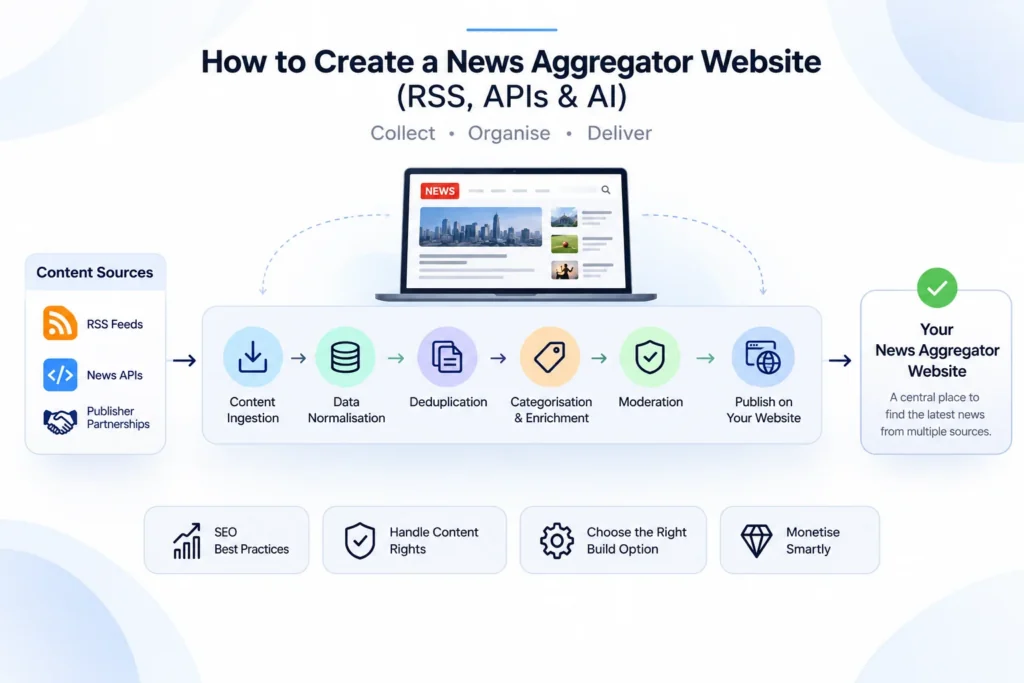
Each stage has a specific responsibility:
- Ingestion: Collects permitted updates from configured sources.
- Normalisation: Converts different source formats into a consistent structure, such as headline, source, date, category and original URL.
- Deduplication: Identifies identical or closely related stories so the same event does not appear repeatedly without context.
- Categorisation: Assigns topics, locations, industries or other relevant labels.
- Enrichment: Adds useful metadata, source details and approved summaries where permitted.
- Moderation: Checks content and sources before publication, either automatically or through editorial review.
- Publication: Displays approved items in the appropriate sections of the website.
- Monitoring: Tracks source failures, outdated items, corrections, removals and site activity.
What should the system store?
Not every aggregator needs to store full article content. A headline-and-link model may only need permitted metadata, a short approved excerpt and the original URL. A licensed model may need to store additional content under the terms of its agreements.
The system should also maintain source information, publication dates, category assignments and content status. This makes it easier to trace an item to its origin and respond when a publisher requests a correction or removal.
What should administrators be able to control?
An administrator should be able to manage sources, review incoming items, update categories and control publication. Editorial roles can help separate routine content checks from higher-level publishing decisions.
Refresh schedules also matter. Checking every source too frequently may create unnecessary processing, while checking too slowly can leave the website displaying outdated information.
The platform you choose affects how these workflows are managed. Review the best CMS for news websites when deciding whether an existing publishing system can support your planned ingestion and editorial process.
If it cannot, news CMS development may be worth considering for more specialised content handling and administrative requirements.
How Do You Automate Categorisation and Moderation, and Where Does AI Help?
Automation reduces repetitive work, but it should not remove editorial responsibility. A news aggregator needs clear rules for what it accepts, how it classifies stories and what happens when content needs attention.
Start with basic rules before adding AI. For example, you might assign stories from an approved source to a predefined category or flag items that contain missing information.
AI can support more complex organisation, but its output should be treated as assistance rather than verified editorial fact.
Where AI can help
| Task | Responsible use of AI |
| Categorisation | Suggests topics or sections based on the story’s subject |
| Entity tagging | Identifies possible people, organisations, locations or products for editorial review |
| Story clustering | Groups similar reports about the same event across different sources |
| Translation support | Helps prepare draft translations for human checking, where the content rights permit it |
| Summary drafting | Produces draft summaries for human review when the source agreement allows summarisation |
For example, a regional news hub might collect several reports about the same public development. A clustering system can group related stories so readers can compare coverage instead of seeing repeated headlines as unrelated items.
An industry news aggregator might use categorisation to separate policy announcements, company news and technology updates. Editors can then review whether the suggested categories make sense.
What should moderation check?
Moderation protects the quality and reliability of the website. Useful checks include:
- Source quality: Accept updates only from reviewed and approved sources.
- Spam: Flag promotional, misleading or irrelevant submissions.
- Duplicate stories: Identify repeated or closely related content.
- Attribution: Check that the original publisher is clearly identified.
- Rights: Confirm that the proposed display and processing follow the source agreement.
- Corrections: Provide a process for updating inaccurate or corrected information.
- Takedown requests: Give administrators a way to review and remove disputed content promptly.
Where AI becomes risky
Automatically rewriting full articles is not a safe shortcut. Rewording another publisher’s reporting does not automatically remove copyright concerns or make the result original.
AI-generated summaries can also contain factual errors, omit important context or misrepresent a source. If the publisher’s terms restrict automated summarisation, using AI may breach those conditions.
Keep a human review process for published summaries and sensitive stories. AI should help editors organise information, not decide whether content is accurate, authorised or appropriate to publish.
How Do You Avoid SEO and Duplicate-Content Problems?
An aggregator can collect useful information and still struggle in search results if its pages offer little beyond content already available elsewhere.
Google’s scaled content abuse policy addresses pages created at scale primarily to manipulate search rankings rather than help users. Its examples include scraping feeds or other websites and combining or transforming content without adding meaningful value. The policy applies regardless of whether the content comes from AI, automation or human production.
This makes the value of your aggregator central to its search strategy. A website that simply republishes headlines or generates large numbers of near-identical pages may have difficulty establishing a useful purpose for search visitors.
What does adding value look like?
Value should come from the way your site selects, organises and explains information. A niche aggregator, for example, can help readers follow a specific industry instead of browsing unrelated general news.
Useful additions may include:
- Focused curation: Select stories relevant to a clearly defined audience.
- Useful categories: Organise coverage by topic, region, industry or event.
- Editorial context: Explain why a group of reports matters without presenting unsupported claims.
- Original material: Add reporting, commentary or analysis created by your own team.
- Clear attribution: Identify the original publisher and link to its reporting.
- Useful navigation: Help readers compare related coverage and discover relevant topics.
How should you handle duplicate and republished content?
When your rights only permit headlines, excerpts and links, keep the presentation within those permissions and direct readers to the original publisher.
If you republish full content with permission, consider Google’s guidance on duplicate content. Blocking republished versions from indexing or using an appropriate canonical tag pointing to the original can help communicate which page is the source. The correct approach depends on the publishing arrangement and page setup.
Avoid creating large numbers of automatically generated topic pages that contain little useful information. A page should exist because it helps readers understand or discover a subject, not simply because the system can create it.
SEO checks before launch
- Use clear page titles and descriptions.
- Organise categories around genuine reader needs.
- Keep source attribution visible.
- Check that original links work.
- Avoid thin pages with little unique value.
- Review indexing for automatically generated pages.
- Keep page structure and navigation understandable.
- Monitor technical issues and outdated content.
No CMS, AI tool or content strategy guarantees search rankings. Google News also applies its own content policies and eligibility requirements. Inclusion should not be treated as something an aggregator can secure simply by connecting news feeds.
How Can a News Aggregator Make Money?
A news aggregator needs a revenue model that fits its audience and content agreements. A large collection of headlines does not automatically create a sustainable business. The site needs a defined audience, a reason for readers to return and a monetisation approach that respects source restrictions.
Possible models include:
- Advertising: Display advertising may suit a site with a clearly defined audience and consistent readership. Check that source agreements and applicable requirements permit the intended commercial use.
- Sponsorship: Relevant businesses may sponsor a newsletter, category or curated news section. Keep sponsored placements clearly distinguishable from editorial content.
- Newsletter: Send selected stories and original context to subscribers. Confirm that your source agreements permit the planned summaries and distribution.
- Affiliate partnerships: Relevant product or service links may support revenue where they fit the audience and comply with applicable terms.
- Premium filters or alerts: Offer additional ways for readers to follow specific topics, industries or developments.
A niche audience can make the business proposition clearer. For example, a specialist industry hub may serve professionals who need updates about a particular market. A regional aggregator may focus on local developments that readers find difficult to follow across multiple sources.
However, commercial plans must influence sourcing decisions from the beginning. A publisher may allow a headline link for personal discovery but restrict commercial reuse, summaries or redistribution. Confirm those conditions before designing the revenue model around the content.
Should You Use Existing Tools or Build a Custom Aggregator?
You do not necessarily need a custom platform to launch a news aggregator. An existing CMS and an RSS aggregation plugin may be sufficient for a small project with a limited number of sources and straightforward editorial needs.
Custom development becomes more relevant when the workflow requires specialised source handling, deduplication, moderation or administrative controls.
| Factor | Existing tools | Custom build |
| Initial setup | Can provide a quicker starting point | Requires planning and development |
| Source handling | Depends on supported feeds and integrations | Can be designed around the selected sources |
| Categorisation | Uses available rules and platform features | Can support project-specific classification workflows |
| Deduplication | May require additional tools or manual checks | Can be designed around the aggregator’s content patterns |
| Moderation | Depends on available editorial controls | Can support tailored review and takedown processes |
| Flexibility | Limited by the chosen platform and extensions | More control over the system’s structure |
| Maintenance | Requires platform, plugin and hosting updates | Requires ongoing technical ownership and maintenance |
When existing tools may be enough
Consider an existing setup when you are testing a focused idea, collecting a small number of permitted feeds or publishing a curated newsletter alongside a simple website.
A plugin-based approach can help validate whether readers find the topic useful before you invest in a larger system. You still need to check plugin capabilities, source terms, content quality and moderation responsibilities.
When custom development may make sense
A custom aggregator may be appropriate when you need to connect multiple source types, manage complex content permissions or support editorial workflows that existing tools cannot accommodate.
For example, a regional portal may need different categories and review rules for several locations. A specialist industry hub may need to group related reports, manage approved sources and provide editors with more control over publication.
Custom development also introduces responsibilities. You need a plan for technical maintenance, hosting, processing, source changes and ongoing moderation.
Consider a phased approach
Rather than building every planned feature immediately, define a smaller first version:
- Select a specific audience and content model.
- Confirm the rights for a limited group of sources.
- Build the ingestion and editorial review process.
- Test categorisation, duplicate handling and publication.
- Gather feedback from readers and editors.
- Expand sources and functionality only when the model justifies it.
Before commissioning development, document the source list, permitted content types, editorial roles, moderation rules, expected content volume and ownership responsibilities. These decisions help establish whether existing tools are sufficient or a custom build is justified.
What Mistakes Should You Avoid?
A news aggregator can become difficult to operate when its owners treat content collection as the entire product. Avoid these common mistakes:
- Assuming feeds are free to republish: Check the publisher’s terms and obtain permission where required.
- Depending on a free API for commercial use: Verify production and commercial rights directly with the provider.
- Automatically rewriting every article: AI rewriting does not remove copyright or accuracy concerns.
- Skipping moderation: Prepare source checks, corrections and takedown procedures before launch.
- Choosing an overly broad topic: Give readers a clear reason to use your site instead of visiting general news websites.
- Ignoring maintenance: Plan for failed feeds, changing API terms, outdated content and technical updates.
Why Choose Qrolic
Qrolic Technologies is a web design and development agency with a WordPress focus, making its background relevant when evaluating an existing CMS or a tailored website build. If you are considering a news aggregator project and want to discuss its design or development requirements, you can Contact Qrolic.
Our Web Services for News Portal Businesses
- News Portal Website Design and Development Services: This service is relevant when you need a public-facing website designed and developed around your news aggregator concept. The project can begin with the site’s structure, content presentation and reader experience.
- News CMS Development: This service is relevant when an existing content system does not accommodate your planned publishing process. It provides an option to build or customise a CMS around content handling, editorial controls and administrative requirements.
Conclusion
Learning how to create a news aggregator website starts with choosing a suitable model and confirming the rights to use each source. RSS feeds, APIs and publisher partnerships can support content collection, but they do not remove your responsibilities around licensing, attribution and moderation.
Build a pipeline that can organise and review content, use AI as an editorial aid, and give readers value beyond republished headlines. Start with a focused audience and a manageable source plan. Then choose existing tools or custom development based on what the project genuinely requires.
Plan Your News Aggregator Project
Discuss your content sources, publishing model and development requirements before committing to a build.
What is a news aggregator website?
A news aggregator website collects and organises news from multiple sources in one place. It may display permitted headlines and links, licensed articles, curated collections or a combination of aggregated and original content.
Is it legal to use RSS feeds on my website?
It depends on the publisher’s terms, the content you display and the laws that apply in your jurisdiction. An RSS feed does not automatically grant permission for commercial republication. Check each source’s terms and seek legal advice before using its content.
Which news API should I use?
Choose an API based on its source coverage, content fields, update frequency and licensing conditions. Check whether its terms permit commercial use, storage, display and summarisation. Do not assume a free development plan is suitable for a production website.
Can a news aggregator rank on Google?
An aggregator may appear in search results, but collecting and republishing content alone does not guarantee visibility. Focus on useful curation, clear organisation, original context and content that serves a specific audience. Avoid generating large numbers of pages with little added value.
Can I use AI to rewrite or summarise news?
AI can help categorise stories, group related reports and draft summaries for human review. However, automated rewriting does not remove copyright concerns. Check the source’s terms, review summaries for factual accuracy and keep editorial oversight.
How do news aggregators make money?
Possible revenue models include advertising, sponsorships, newsletters, affiliate partnerships and premium alerts or filters. The right approach depends on the audience and the permissions attached to your content sources.
What is the difference between RSS and a news API?
RSS and Atom feeds provide structured updates published by websites. A news API provides information through a service that your system can request. Both can support automated collection, but their available content and usage permissions depend on the source and its terms.
Should I use a plugin or build a custom news aggregator?
An existing CMS and aggregation plugin may suit a small project with straightforward source and editorial requirements. Custom development may be more appropriate when you need specialised ingestion, deduplication, moderation or administrative workflows. Test the basic model before committing to a larger build.
What happens if a publisher objects to my content?
Review the publisher’s request and the agreement or terms governing that content. Your system should allow administrators to investigate the item, remove or update it where appropriate, and document the response. A clear takedown process helps you handle disputes responsibly.
What should I do before building a news aggregator?
Start by defining your audience, aggregator model and initial source list. Confirm what each source permits, choose a suitable revenue approach and document the ingestion, moderation and editorial workflow. These decisions will help you determine which platform or development approach fits the project.
Enjoying our content?