SEO for Universities That Helps Students Find Your Programs
Help prospective students discover your academic programs and take the next step toward enrollment. Qrolic provides SEO for universities and colleges focused on program-level visibility.
Trusted by large companies worldwide.










Introduction
Make Your Academic Programs Easier to Find
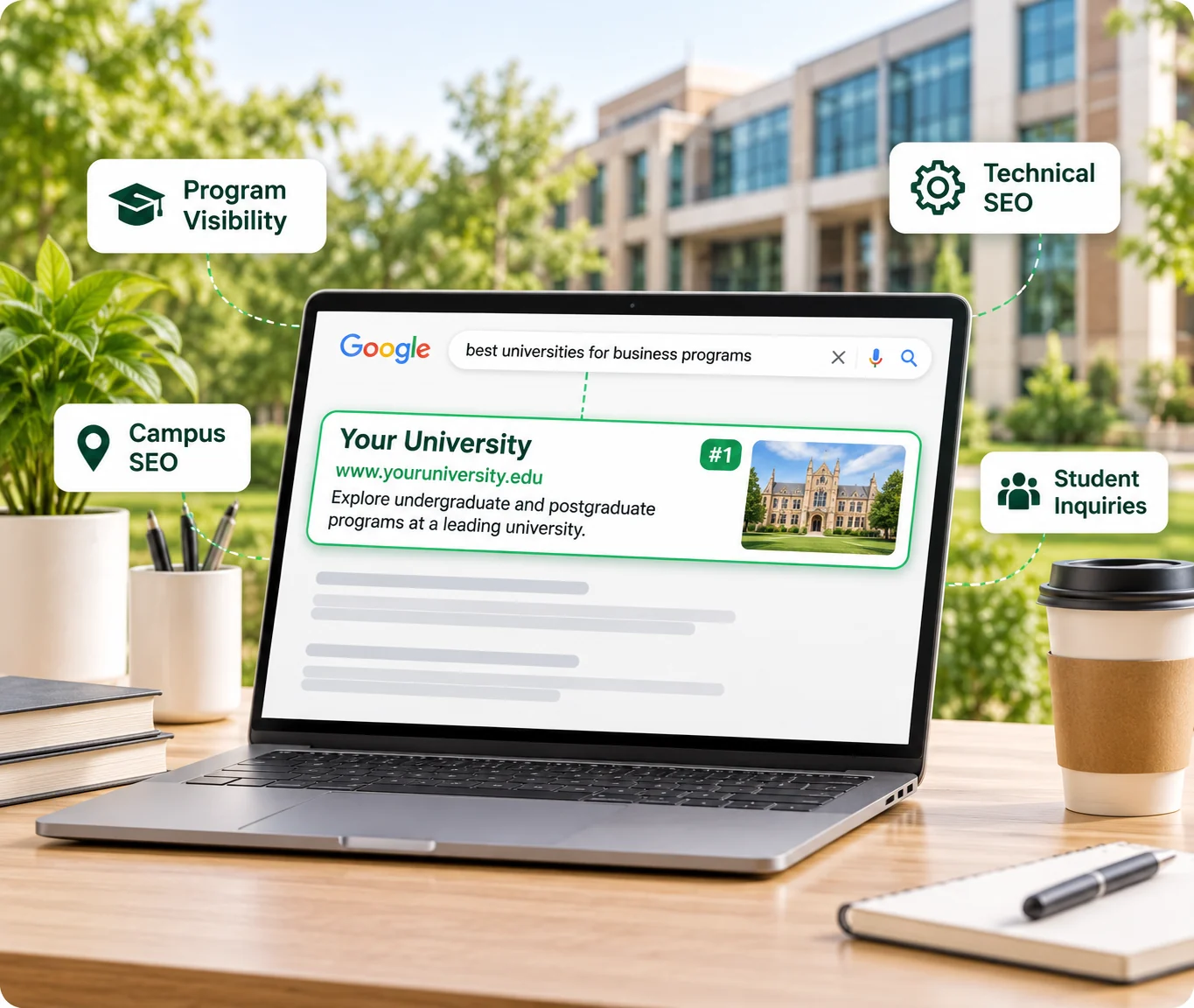
Students research institutions long before they apply. SEO helps colleges and universities appear for the degree, admission, and tuition searches students use.
Visibility
Discovery
Measurement
Our Capabilities
- Technical SEO for Universities
- Program-Level Keyword Research
- On-Page SEO for Program Pages
- Local SEO for Campuses
- Off-Page SEO and Authority
- AI Search Readiness
- Enrollment-Focused Reporting

University SEO Services
SEO Built Around Higher Education Challenges
University websites often hold hundreds or thousands of pages across departments. A generic SEO strategy may overlook the technical and organizational challenges of that scale.
01
What Do University SEO Services Include?
University SEO services cover technical SEO, program-level keyword research, on-page SEO, local SEO, off-page authority building, AI search readiness, and enrollment-focused reporting, scoped to your website and goals.
02
Why Does SEO Matter for Colleges and Universities?
Students compare programs, fees, and admission requirements long before applying. Carnegie research reported by ICEF Monitor found that AI tool use in college search among graduating seniors rose from 10% in 2024 to 23% in 2025.
03
How Does Qrolic Address Higher Education SEO Challenges?
Qrolic audits technical health, maps keywords to program pages, strengthens local and off-page signals, and reports on inquiries where tracking is configured, so teams can see how search supports enrollment activity.
04
Who Needs University SEO Services?
The service supports private colleges, public universities, community colleges, online program providers, and multi-campus systems that want prospective students to find their programs through organic search.
Our Approach
Qrolic follows four phases: Technical & On-Page SEO, Academic Keyword & Content Strategy, Local & Off-Page Authority, and
Analysis & Reporting. Each phase has defined activities, your involvement, and an outcome.
Benefits
Build Search Visibility Around Student Searches
A focused SEO strategy helps students find the programs and information they search for, and gives your team clearer insight into how organic search supports inquiries.

Clearer Program Targeting
Map degree and specialization searches to the right pages. Give each important program page a clear search purpose.

Stronger Technical Foundation
Review crawling, indexation, speed, and canonical issues across large websites. Prioritize fixes by potential impact.

More Useful Program Pages
Improve titles, headings, and content structure on program and admission pages without forcing keywords into the content.

Local Campus Visibility
Plan local SEO around individual campuses while keeping a consistent institutional identity.

Relevant Academic Authority
Focus on relevant, credible links from education publications, academic resources, and associations rather than bulk links.

Enrollment-Focused Reporting
Where tracking is configured, report on inquiries and application-related activity alongside rankings and traffic.
Help More Students Find Your Programs
Free UX Audit
Build an SEO strategy around your programs, campuses, and enrollment priorities.

Our Workflow
Our Four-Phase Higher Education SEO Process
Our process brings technical optimization, academic keyword research, local visibility, authority building, and performance measurement together.
01
Technical & On-Page SEO
02
Academic Keyword & Content Strategy
03
Local & Off-Page Authority
04
Analysis & Reporting
Step 01
Technical & On-Page SEO
We evaluate technical health, crawling, indexation, speed, and mobile usability, and optimize program and admission pages. You provide website and analytics access and review the audit. The outcome is a technical foundation and prioritized recommendations.
Step 02
Academic Keyword & Content Strategy
We research the degree, subject, and admission searches students use, map keywords to existing pages, and identify content gaps. You share priority programs and admission details. The outcome is a keyword map aligned with student search intent.
Step 03
Local & Off-Page Authority
We review campus location pages, local citations, and competitor backlinks, and plan relevant authority-building activities. You confirm campus details and approve outreach where required. The outcome is a stronger foundation for local and external visibility.
Step 04
Analysis & Reporting
We monitor rankings, organic traffic, and program page performance, plus inquiry and application-related tracking where configured. You review reports and confirm changing priorities. The outcome is a report connecting SEO activity with visibility and available inquiry data.
Comparison
Why Higher Education SEO Needs a Specialist Approach
A generic SEO strategy may overlook large websites, program-level searches, and enrollment goals. A higher education approach considers these from the start.
Without Qrolic:
Without Qrolic :
- Programs not visible in search
- Technical complexity at scale
- Similar program pages compete
- Admission details hard to find
- Campus locations lack visibility
- Limited external authority
- SEO results hard to justify
- AI systems misread content
With Qrolic:
With Qrolic :
- Program-level keyword mapping
- Technical audits and crawl analysis
- Content differentiation
- Optimized admission content
- Local SEO and location pages
- Relevant backlink research
- Enrollment-related reporting
- Structured content and schema
Case Studies
Explore Qrolic’s Higher Education SEO Approach
This page does not present unverified higher education case studies, testimonials, or results. Results depend on the existing website, competition, and campaign scope.
Building the First TailoredPay Payment Gateway Plugin for WordPress & Gravity Forms
Overview TailoredPay had no existing WordPress integration available — not…

Uketa Support – Multi-Language Immigration Platform with Secure Cross-Site Payments
Overview Uketa Support is a multi-language immigration assistance platform built…

My Passport Center – Immigration Platform with Secure Payment Infrastructure
Overview My Passport Center is a high-volume immigration services platform…

Martens – Employment Hero API Integration for WordPress
Overview Martens required a custom careers platform capable of pulling…

First Pass Airport Services – Google Maps Distance Pricing Integration
Overview First Pass Airport Services operates a luxury chauffeur service…

Drip Hydration UK Case Study – HIPAA-Aligned LatePoint Data Encryption
Overview Drip Hydration UK operates a healthcare-focused appointment booking platform…

Custom Brevo API Integration for WordPress — Transactional Emails & Workflow Automation
Overview The client’s immigration platforms relied on WordPress wp_mail for…

Automated WordPress File Migration to S3-Compatible Cloud Storage
Overview The client’s immigration platform was generating hundreds of PDFs…

Azure OCR Integration for WordPress – Custom Document Scanning & Auto-Fill Plugin
Overview The client’s immigration platforms required users to manually enter…

Building a Frontend Application Management Dashboard for WordPress
Overview Managing hundreds of applications directly from the WordPress admin…
Why Choose Qrolic
Why Choose Qrolic for Higher Education SEO?
Qrolic brings technical, on-page, off-page, and local SEO together in one four-phase workflow, built around program-level searches and enrollment-oriented reporting.
0+
Years of WordPress
Delivering top-tier digital services across design, development, and performance.
0+
Happy Clients
Serving global brands with a 95%+ satisfaction rate across industries.

0%
Client satisfaction
We’re committed to delivering solutions that truly make an impact.
0+
Team members
A strong team of experts in WordPress, web technologies, and UI/UX.
Start a Conversation
Improve Your University’s Search Visibility
Tell us about your programs, campuses, and enrollment priorities. We can review your website, identify SEO opportunities, and discuss a strategy aligned with your goals.
Curious About the Cost? Free
Our website cost calculator is built using real
project data – no guesswork, just honest pricing.
 Message on WhatsApp

Curious About the Cost? Free
Just drop your requirements on WhatsApp, and we’ll send you an instant estimate—no forms, no waiting.
Frequently Asked Questions
Common Questions About University SEO
Learn what higher education SEO covers, how it differs from general SEO, and how reporting,
local SEO, and AI search readiness are handled.
What Is SEO for Universities?
SEO for universities is the process of improving a higher education institution’s visibility in organic search results. It includes technical SEO, program-level keyword research, on-page optimization, local SEO, backlink development, and content improvements that help prospective students discover academic programs and institutional information.
What Is Included in Higher Education SEO Services?
Higher education SEO services can include technical SEO audits and fixes, program-level keyword research, on-page optimization for academic, admission, and faculty pages, local SEO and campus visibility, backlink analysis and authority building, AI search readiness recommendations, competitor research, organic performance reporting, and inquiry and application-related tracking where configured. The exact scope depends on the institution’s website, goals, and campaign requirements.
How Much Do University SEO Services Cost?
Cost depends on the size and complexity of the website, the number of academic programs, competition, and the activities included. Factors include the number of program and department pages, technical SEO requirements, keyword and content strategy scope, local SEO needs across campuses, backlink activities, and reporting requirements. Contact Qrolic to discuss your requirements and request an estimate.
Why Are Our University Programs Not Ranking in Google?
Programs may struggle to rank because of broad keyword targeting, thin or duplicated content, technical SEO issues, weak internal linking, limited external authority, or strong competition. An SEO audit can help identify whether the main issues are technical, content-related, or competitive.
How Is Higher Education SEO Different From General SEO?
Higher education SEO considers academic program structures, degree-specific searches, admission requirements, faculty information, campus locations, seasonal recruitment periods, and the complexity of large institutional websites. A general SEO strategy may not address these needs in enough detail. A higher education SEO provider should understand how to organize and optimize these different areas.
How Do You Track Student Applications From SEO?
Where the website and analytics setup support it, tracking can measure inquiry form submissions, application-related button clicks, program page engagement, important landing page conversions, and organic traffic and conversion trends. More advanced application attribution may require access to the institution’s application platform or CRM and a separately agreed integration.
How Long Does SEO Take to Show Results for a University?
SEO is an ongoing process, and the time needed depends on the website’s current condition, competition, implementation speed, and scope of work. Technical fixes may improve specific issues sooner, while stronger rankings for competitive programs can take longer. Performance should be reviewed consistently rather than judged by a single short-term ranking change.