Ecommerce SEO Agency Focused on Measurable Store Growth
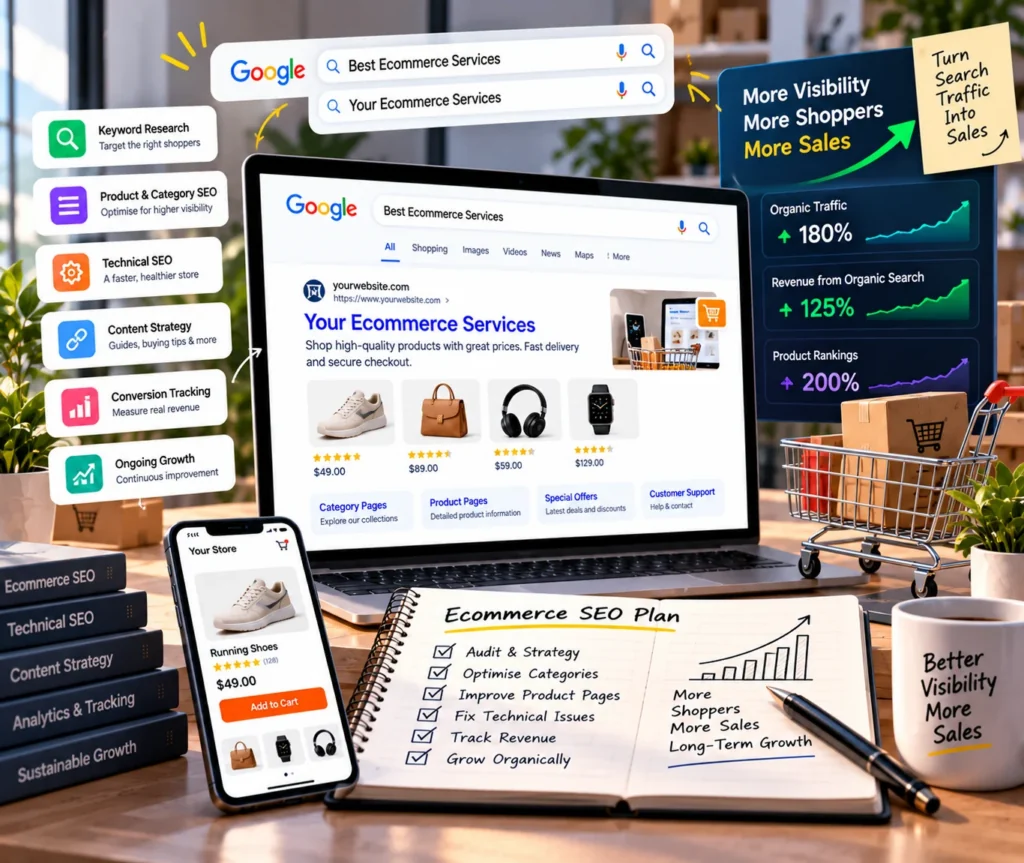
Qrolic’s ecommerce SEO services combine keyword research, on-page and technical SEO, content planning and revenue-aware measurement around your catalogue, customers and growth priorities.
Trusted by large companies worldwide.
















Introduction
Help Shoppers Find Your Products in Search
SEO for ecommerce helps shoppers discover relevant categories and products, and gives you a way to see how organic search contributes to sales and other defined outcomes.
Relevance
Technical Health
Revenue Measurement
Our Capabilities
- Ecommerce SEO Strategy
- Category Page SEO
- Product Page SEO
- Technical SEO for Ecommerce
- Ecommerce Keyword Research
- Ecommerce Content Strategy
- Conversion Review and Monitoring

Ecommerce SEO Services
SEO Built Around Your Online Store
Our ecommerce SEO services cover strategy, measurement, site structure, content, technical improvements, conversion review and ongoing monitoring.
01
What Does the Service Include?
The service covers strategy, keyword research, category and product page SEO, technical SEO, content strategy, conversion review, authority building, monitoring and migration planning, with local SEO where it applies.
02
Why Does SEO for Ecommerce Matter?
Catalogues, category hierarchies, variants, filters and changing inventory create structural and technical considerations. Without management, key pages can be hard to find, category pages can miss shopper intent and visibility can suffer.
03
How Does the Service Address These Challenges?
We set up measurement first, audit duplicate and thin pages, crawl and indexing issues, speed and mobile usability, and rank findings by likely impact so effort goes to the category and product pages that matter.
04
Who Is This Service For?
It suits online retailers, direct-to-consumer brands, stores with large catalogues or underperforming category pages, businesses with technical SEO problems, stores planning a migration and retailers with physical locations.
Our Approach
We begin with your goals, audience, market and competitors, then move through measurement, research, structure, audits, content, on-page and technical work, authority building and monitoring, adding migration planning when needed.
Benefits
Benefits of Ecommerce SEO for Your Store
Focused SEO can make product and category pages more relevant and easier to crawl, with measurement that ties organic activity to outcomes. Results vary by store, market and competition.

More Relevant Product and Category Pages
Keyword research and on-page work align important pages with shopper searches, covering titles, headings, content, internal links, images and structured data.

A Store That Is Easier to Crawl
Clear site structure, canonicalisation, redirects and sitemap management help search engines understand page relationships and find key content.

SEO Linked to Business Outcomes
Conversion tracking adds context beyond traffic and rankings, showing how organic search relates to purchases, revenue or leads where tracking is available.

Content That Answers Buyer Questions
Content planning supports shoppers at different stages of the buying journey, around products, categories and relevant topics.

Priorities Based on Impact
Audit findings are ranked so large catalogues are not treated as one long list of equally urgent tasks.

A Sustainable Improvement Process
Ongoing monitoring tracks rankings, traffic, conversions, competitors and content, and shows which issues deserve attention next.
Help Shoppers Discover Your Online Store
Free UX Audit
Plan an SEO approach that covers category and product pages, technical health and revenue-aware measurement.

Our Process
How Qrolic Approaches Ecommerce SEO Work
The process is built around measurable goals, prioritised improvements and ongoing evaluation, with each stage supporting a broader ecommerce SEO strategy.
01
Understand Your Business
02
Plan the User Experience
03
Design a Distinctive Interface
04
Build the WordPress Website
05
Set Up Editable Content and CMS
06
Keep the Build Lean
07
Connect Tools and Add Functionality
08
Review Progress on Staging
09
Train and Hand Over Ownership
Step 01
Start With Your Business Goals
We review your audience, offerings, market, locations, competitors and objectives to keep SEO priorities aligned with your commercial goals.
Step 02
Make Every Result Measurable
We establish analytics, Google Search Console and conversion tracking before optimisation, giving a baseline and, where tracking supports it, a view of leads, purchases and revenue from search.
Step 03
Find the Searches That Matter
We research competitors, search demand and keyword intent across products, categories and locations to find searches that match what you offer.
Step 04
Review Structure and Fix SEO Issues
We review pages, URLs, topics and internal links, then audit on-page, technical, local, off-page and security issues and rank them by likely impact.
Step 05
Create Content and Optimise Pages
We plan content around customer questions, products and search intent, and improve titles, headings, content structure, internal links, images and schema.
Step 06
Strengthen Your Technical Foundation
We address crawlability, indexing, speed, Core Web Vitals, mobile usability, redirects, canonicalisation and sitemaps, guided by audit findings.
Step 07
Improve Local Visibility and Conversion
We review calls to action, trust signals and page layouts that affect the path to purchase. For stores with physical locations, local SEO may include Google Business Profile and citations.
Step 08
Build Your Website’s Authority
We consider quality backlinks, digital PR, brand mentions and citations, selected by relevance and agreed scope.
Step 09
Monitor Progress and Protect SEO
We monitor rankings, traffic, conversions, competitors and content performance. For a redesign or replatform, we plan redirects, key URLs, new-site audits and before-and-after comparisons.
Comparison
Choose Ecommerce SEO Support With Purpose
SEO for online stores can involve an agency, a consultant or an in-house team. The right fit depends on your resources; a structured process keeps work tied to business goals.
Without Qrolic:
Without Qrolic :
- Rankings may be tracked alone
- Large catalogues may stay unsorted
- Category pages may miss intent
- Duplicate pages may go unreviewed
- Crawl issues may be overlooked
- Migration risks may be missed
- SEO may be one-off work
With Qrolic:
With Qrolic :
- Revenue-aware measurement
- Issues ranked by likely impact
- Category page SEO by intent
- Duplicate and thin page audit
- Crawl and indexing review
- Redirect and URL planning
- Ongoing monitoring and review
Case Studies
See How We Plan Ecommerce SEO
Qrolic’s workflow runs from goals and measurement to optimisation and monitoring. Discuss your requirements to see how it would apply to your online store.
Building the First TailoredPay Payment Gateway Plugin for WordPress & Gravity Forms
Overview TailoredPay had no existing WordPress integration available — not…

Uketa Support – Multi-Language Immigration Platform with Secure Cross-Site Payments
Overview Uketa Support is a multi-language immigration assistance platform built…

My Passport Center – Immigration Platform with Secure Payment Infrastructure
Overview My Passport Center is a high-volume immigration services platform…

Martens – Employment Hero API Integration for WordPress
Overview Martens required a custom careers platform capable of pulling…

First Pass Airport Services – Google Maps Distance Pricing Integration
Overview First Pass Airport Services operates a luxury chauffeur service…

Drip Hydration UK Case Study – HIPAA-Aligned LatePoint Data Encryption
Overview Drip Hydration UK operates a healthcare-focused appointment booking platform…

Custom Brevo API Integration for WordPress — Transactional Emails & Workflow Automation
Overview The client’s immigration platforms relied on WordPress wp_mail for…

Automated WordPress File Migration to S3-Compatible Cloud Storage
Overview The client’s immigration platform was generating hundreds of PDFs…

Azure OCR Integration for WordPress – Custom Document Scanning & Auto-Fill Plugin
Overview The client’s immigration platforms required users to manually enter…

Building a Frontend Application Management Dashboard for WordPress
Overview Managing hundreds of applications directly from the WordPress admin…
Why Choose Qrolic
Why Choose Qrolic for Ecommerce SEO
We start from business objectives, measure before optimising and rank issues by impact. Conversions are considered alongside traffic, and redesigns are planned for.
0+
Years of WordPress
Delivering top-tier digital services across design, development, and performance.
0+
Happy Clients
Serving global brands with a 95%+ satisfaction rate across industries.

0%
Client satisfaction
We’re committed to delivering solutions that truly make an impact.
0+
Team members
A strong team of experts in WordPress, web technologies, and UI/UX.
Discuss Your Project
Let’s Plan Your Ecommerce SEO Strategy
Share your catalogue, goals and current SEO challenges to help define a suitable scope. Qrolic can then outline how its process would apply to your store.
Curious About the Cost? Free
Our website cost calculator is built using real
project data – no guesswork, just honest pricing.
 Message on WhatsApp

Curious About the Cost? Free
Just drop your requirements on WhatsApp, and we’ll send you an instant estimate—no forms, no waiting.
Frequently Asked Questions
Common Questions About Ecommerce SEO Services
Learn how ecommerce SEO handles product and category pages, duplicate content, migrations and measurement, and how to compare providers.
What is ecommerce SEO?
Ecommerce SEO improves an online store’s visibility in organic search results. It includes keyword research, category and product page optimisation, site structure, technical SEO, content planning and performance monitoring. The aim is to help relevant shoppers discover the store and to measure how organic search contributes to business goals.
How is SEO for ecommerce different from regular SEO?
SEO for ecommerce must account for product catalogues, category hierarchies, variants, filters and potentially large numbers of similar URLs. Category and product page targeting, duplicate content management, crawlability and canonicalisation therefore need particular attention.
How do you optimise product pages for SEO?
Product page SEO can include researching search intent, improving titles and headings, making content more useful, reviewing internal links and images and adding appropriate structured data. The specific changes depend on the page, existing content and audit findings.
How do you improve category page SEO?
Category page SEO aligns each category with relevant shopping searches. It may involve reviewing keyword targeting, titles, headings, category content, internal links and the relationship between categories and their products, so pages are clearer for shoppers and search engines.
How do you handle duplicate content on ecommerce websites?
The approach depends on why duplicate or similar pages exist. An audit may review variants, filters, URL parameters, canonical tags, internal links and indexation settings. Not every similar page should be removed or blocked from indexing, so the solution reflects each page’s purpose.
How do you address crawl and indexing issues on large stores?
We review how important pages are linked, how URLs are generated and whether canonical tags, redirects and sitemaps work as intended. Issues are prioritised by their likely effect on important category, product and content pages.
How is ecommerce SEO connected to revenue?
When analytics and conversion tracking are set up properly, you can examine how organic visits relate to purchases, revenue, leads or other defined outcomes. Attribution is not always straightforward, so reporting should reflect the available data and its limits.
How long does ecommerce SEO take to show results?
There is no universal timeline. Results depend on the website’s condition, competition, catalogue, technical issues, content and implementation. Some technical issues can be addressed early, but changes in visibility and business outcomes vary. A realistic timeline is discussed after reviewing the store.
How much do ecommerce SEO services cost?
Cost depends on catalogue size, technical complexity, content requirements, competition, migration needs and the scope of ongoing work. Specific prices are not listed on this page, and the scope and pricing model are confirmed before an engagement begins.
Can you protect SEO during an ecommerce website migration?
The process includes migration planning when applicable. This can involve mapping important URLs, planning redirects, reviewing the new website and comparing performance before and after launch. These measures reduce avoidable risks but cannot promise that rankings or traffic will stay unchanged.
Which ecommerce platforms do you support?
Platform compatibility is confirmed during scoping. If your store uses a particular platform or you plan to replatform, share that information so technical requirements can be evaluated.
Do you provide local SEO for ecommerce businesses?
Local SEO is a conditional stage for businesses with physical locations. Relevant work may include Google Business Profile optimisation, local pages, citations, reviews and local relevance. Its suitability depends on your business model and whether local search is part of your strategy.
Does ecommerce SEO include paid advertising or shopping ads?
No. Paid advertising and shopping ads management are not part of the SEO process. Ecommerce SEO focuses on organic visibility and the website improvements that support it. Any paid media or product feed services would need to be confirmed separately.
What is ecommerce search engine optimisation?
Ecommerce search engine optimisation is another name for improving an online store’s organic search visibility, including keyword research, category and product page improvements, technical SEO, content planning and monitoring. Optimisation is the British spelling and optimization the American, so the preferred form should match your target market.
What is the difference between an ecommerce SEO agency and an ecommerce SEO consultant?
An ecommerce SEO agency delivers SEO under an agreed engagement, while an ecommerce SEO consultant is an individual specialist who may provide strategy, advice or implementation. Responsibilities vary, so compare scope, implementation support, communication, measurement and ongoing work rather than the label.