Custom Tour Booking Websites That Simplify Reservations
Build tour booking websites around your tours, availability, pricing, and payment needs. Give travelers a clearer way to search, book, and receive confirmation.
Trusted by large companies worldwide
















Introduction
Make Tour Reservations Easier to Manage
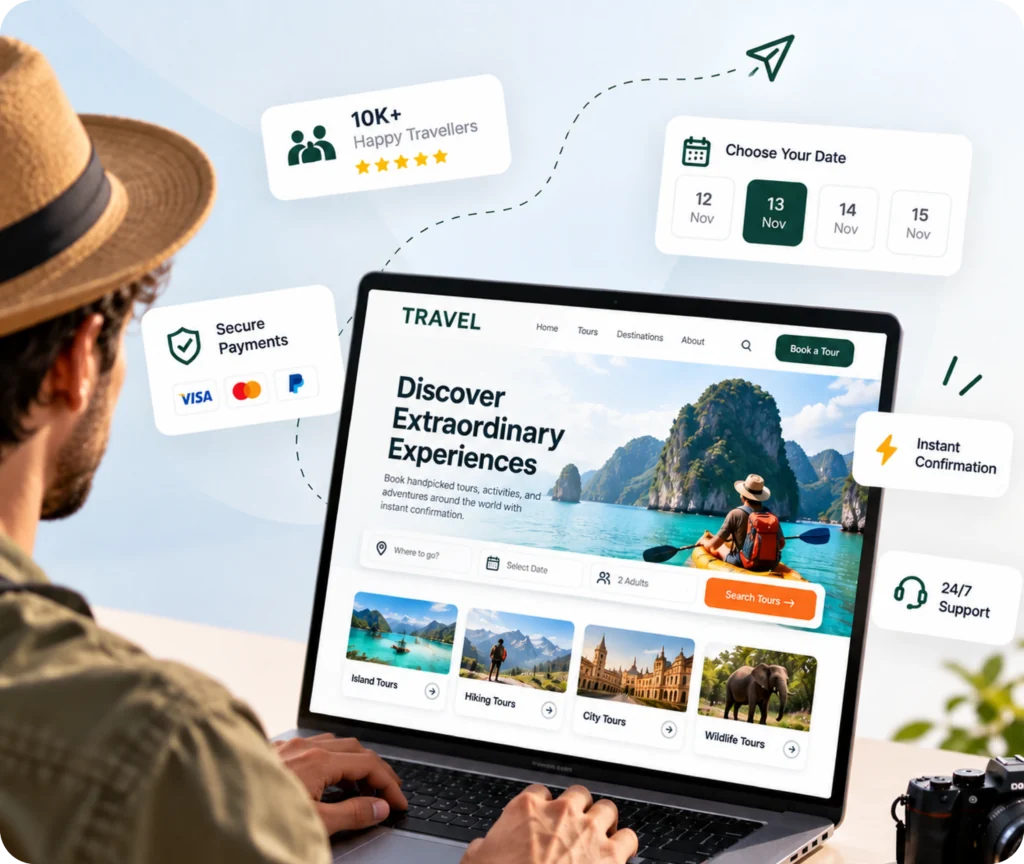
A tour booking engine gives travelers a direct way to find tours, check availability, select options, pay online, and receive booking confirmation.
Bookings
Control
Flexibility
Our Capabilities
- Tour Search and Listings
- Real-Time Availability
- Seat Selection
- Flexible Pricing Logic
- Payment and Deposits
- Booking Admin Dashboard
- Automated Notifications

Service Overview
A Booking Engine Built Around Tours
Tour booking websites need more than a basic contact form or standard checkout. A booking engine connects tour availability, participant details, pricing, payments, and confirmations into one customer journey.
01
What Does It Include?
The service covers tour search and listings, date and participant availability, capacity-based bookings, pricing options, checkout, payment gateways, notifications, and itinerary details. It can also support seat selection for applicable bus and coach tours.
02
Why Does It Matter?
Manual bookings through phone, email, or messages can create delays and increase the chance of errors. A direct booking flow gives travelers a clearer path while helping operators manage availability and booking information from one place.
03
How Does It Solve The Problem?
The booking flow connects tour selection with availability, participant details, pricing, payment, and confirmation. For seat-based tours, an interactive seat map can let customers select available seats while helping operators avoid overselling capacity.
04
Who Is It For?
The service can support independent tour operators, activity providers, bus and coach operators, and travel agencies or destination management companies. The exact booking structure can be shaped around tour types, group needs, and operating requirements.
Our Approach
The process follows Qrolic’s supplied website development workflow, starting with business-focused planning and user experience, then custom functionality, connected tools, staging, management, and ownership. This keeps the booking experience aligned with operational needs.
Benefits
Turn Complex Bookings Into Clearer Journeys
A structured booking engine connects customer actions with operator workflows. It can reduce manual steps while making tour availability and booking information easier to manage.

Faster Booking
Travelers can search, select, pay, and confirm without relying on manual messages.

Fewer Booking Errors
Centralized availability helps reduce duplicate or conflicting reservations.

Direct Bookings
A booking engine creates a direct reservation path through the operator’s own website.

Flexible Pricing
Support participant types, group pricing, private tours, deposits, and other pricing structures.

Better Seat Control
Bus and coach operators can use seat selection and availability controls where required.

Easier Management
An admin dashboard brings bookings, capacity, tours, guides, vehicles, and reporting together.
Ready To Improve Your Tour Booking Flow?
Free UX Audit
Create a clearer reservation journey around your tours, availability, pricing, and customer needs.

Our Process
From Planning To Ownership
The workflow connects customer experience, custom functionality, integrations, testing, and management into a structured development process.
01
Design Around Your Business
02
Create a UX That Guides Visitors
03
Build a Fast, Lightweight WordPress Website
04
Make Your Website Easy to Manage
05
Connect Your Existing Tools
06
Build Custom Functionality
07
Let You See Progress via Staging Site
08
Make Sure You Can Manage It
09
Give You Complete Ownership
Step 01
Design Around Your Business
The booking experience is structured around actual tour types and operating needs rather than a generic template.
Step 02
Create a UX That Guides Visitors
The journey is planned around search, selection, payment, and confirmation so customers can understand each step.
Step 03
Build a Fast, Lightweight WordPress Website
Where a WordPress-based implementation applies, the website is developed around the required booking experience and functionality.
Step 04
Make Your Website Easy to Manage
The management experience allows operators to work with relevant tours, pricing, availability, and booking information.
Step 05
Connect Your Existing Tools
Relevant business tools can be connected where supported, including payment gateways, CRM systems, and applicable integrations.
Step 06
Build Custom Functionality
Custom functionality can address booking requirements that standard plugins or generic systems do not cover.
Step 07
Let You See Progress via Staging Site
A staging environment provides a place to review the work before the website is moved toward launch.
Step 08
Make Sure You Can Manage It
The workflow includes making the website manageable for the customer rather than requiring ongoing developer involvement for routine administration.
Step 09
Give You Complete Ownership
The supplied workflow concludes with complete ownership, giving the customer control of the resulting website.
Comparison
Why Generic Booking Tools May Fall Short
Generic booking approaches may not account for seat selection, tour-specific pricing, or multi-day itineraries. A specialized booking engine can be structured around these requirements.
Without Qrolic:
Without Qrolic :
- Generic booking form
- Manual availability checks
- Basic quantity selection
- Limited pricing logic
- Manual payment handling
- Scattered booking information
- Generic tour details
With Qrolic:
With Qrolic :
- Tour-focused booking flow
- Real-time availability
- Seat selection where needed
- Participant and group pricing
- Integrated checkout options
- Centralized admin dashboard
- Structured itineraries and inclusions
Case Studies
Relevant Work And Verified Results
No verified tour booking case studies, client results, metrics, or testimonials were supplied for this service, so none are presented as examples here.
Building the First TailoredPay Payment Gateway Plugin for WordPress & Gravity Forms
Overview TailoredPay had no existing WordPress integration available — not…

Uketa Support – Multi-Language Immigration Platform with Secure Cross-Site Payments
Overview Uketa Support is a multi-language immigration assistance platform built…

My Passport Center – Immigration Platform with Secure Payment Infrastructure
Overview My Passport Center is a high-volume immigration services platform…

Martens – Employment Hero API Integration for WordPress
Overview Martens required a custom careers platform capable of pulling…

First Pass Airport Services – Google Maps Distance Pricing Integration
Overview First Pass Airport Services operates a luxury chauffeur service…

Drip Hydration UK Case Study – HIPAA-Aligned LatePoint Data Encryption
Overview Drip Hydration UK operates a healthcare-focused appointment booking platform…

Custom Brevo API Integration for WordPress — Transactional Emails & Workflow Automation
Overview The client’s immigration platforms relied on WordPress wp_mail for…

Automated WordPress File Migration to S3-Compatible Cloud Storage
Overview The client’s immigration platform was generating hundreds of PDFs…

Azure OCR Integration for WordPress – Custom Document Scanning & Auto-Fill Plugin
Overview The client’s immigration platforms required users to manually enter…

Building a Frontend Application Management Dashboard for WordPress
Overview Managing hundreds of applications directly from the WordPress admin…
Why Choose Qrolic
A Service Focused On Tour Booking Needs
Qrolic’s service approach is based on business-focused planning, guided user experiences, custom functionality, connected tools, staging, and customer ownership. The available research supports these workflow elements, but does not provide verified tour-specific portfolio results or performance statistics.
0+
Years of WordPress
Delivering top-tier digital services across design, development, and performance.
0+
Happy Clients
Serving global brands with a 95%+ satisfaction rate across industries.

0%
Client satisfaction
We’re committed to delivering solutions that truly make an impact.
0+
Team members
A strong team of experts in WordPress, web technologies, and UI/UX.
Start Your Project
Build A Booking Experience For Your Tours
A focused booking engine can bring tour discovery, availability, pricing, payments, and booking management into one customer journey.
Curious About the Cost? Free
Our website cost calculator is built using real
project data – no guesswork, just honest pricing.


Curious About the Cost? Free
Just drop your requirements on WhatsApp, and we’ll send you an instant estimate—no forms, no waiting.
Frequently Asked Questions
Questions About Tour Booking Engines
Tour operators often need different booking rules, pricing structures, and availability controls. These questions cover common requirements when planning tour booking websites.
What Is A Tour Booking Engine?
A tour booking engine is an online reservation system for tour operators and activity providers. It can let travelers search tours, select dates and participants, check availability, make payments, and receive booking confirmation.
Can Tour Booking Websites Support Bus Tours?
Yes, bus and coach tours can require seat-based booking rather than simple participant counts. A booking engine can support an interactive seat map, real-time seat availability, seat holds during checkout, and seat-level pricing where applicable.
Can The System Support Deposit Payments?
Tour booking websites can include deposit or partial-payment structures where supported by the selected payment setup. Deposits may be configured as a fixed amount, percentage, or scheduled payment structure.
What Is The Difference Between A Booking Engine And A Channel Manager?
A booking engine handles customer reservations on the operator’s own website. A channel manager distributes inventory across connected third-party platforms, such as online travel marketplaces, using a shared availability system.
Can It Connect With Existing Business Tools?
The research brief identifies payment gateways, CRM or ERP systems, and channel managers as integration-dependent areas. The exact integrations included in a project depend on the required scope and supported systems.
Is Custom Development Different From Booking Trip Sites?
Yes. Many booking trip sites use ready-made SaaS platforms or generic plugins. Custom tour reservation system development can instead be structured around specific tour types, availability rules, pricing, seat selection, and administrative requirements.
What Are Online Tour Booking Sites Expected To Provide?
Online tour booking sites generally need a clear path from tour discovery to reservation. Common elements include availability calendars, participant pricing, payments, confirmations, cancellation handling, and customer booking management.